


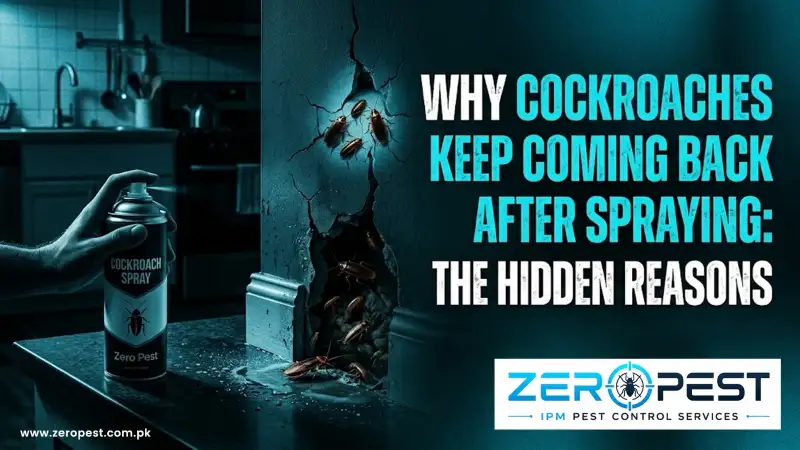
You spray the house, wipe down the kitchen counters, and for a few days the house remains roach-free. But suddenly, one night when you switch on the kitchen light, you see roaches on the kitchen counter or near the leftover food items. It’s normal; you are not alone in this boat. Many individuals think that the spray is the ultimate solution, but it can’t work without taking professional pest control services. You can’t be sure about the cockroach infestation in your property.
A common question many individuals ask is, “Why do cockroaches keep coming back after spraying?” The answer is that spraying is seldom a solution, but with spraying, you can’t reach the harborage area. The roaches you spot inside the house are not necessarily the ones infesting the area; the real problem is likely lurking behind appliances, in cracks in walls, and in kitchen cabinets and other hard-to-reach areas that surface-sprayed insecticide won’t reach.
The best cockroach infestation solution is to hire a professional pest control company like Zero Pest in Islamabad and Rawalpindi. However, before purchasing another spray to kill kitchen cockroaches, you need to understand pest infestation, it is important that you have some knowledge about why cockroaches survive and reappear so you can actually solve the problem rather than just cover it up with another spray.
Why Spraying Doesn’t Always Eliminate Cockroaches
Typical over-the-counter sprays are designed to kill cockroaches upon contact; that’s it. They will kill roaches when they are out of the house and within reach of the spray, but they kill only a small percentage of the roaches that are outside. Cockroaches are nocturnal insects and naturally avoid light and open areas, so they often hide in inaccessible areas that are hard to spray.
Aside from that, there’s also the crucial distinction between killing insects and eliminating an infestation. If you see roaches crawling, killing them might appear to be a solution, but if you do not reach harborage areas, eggs, and food, the population will quickly rebuild within days or weeks. This is why many homes find it necessary to spray numerous times to get rid of cockroaches and never seem to stop having them.
Where Cockroaches Usually Hide
Most people living in Pakistan find cockroaches nesting and hiding in the following places:
- Closets and cabinets in the kitchen, particularly those containing food aisles
- In and around sinks where moisture can build up
- Bathrooms (especially near pipes and drains)
- Gaps or openings around plumbing and around floor drains.
- At the back and bottom of refrigerators
- The use of false ceilings and ceiling voids.
- Cracks in walls, tiles and skirting boards
Because spraying surfaces doesn’t reach roaches’ hiding and harborage areas, this is one reason why cockroach spray is not an effective long-term solution.
7 Reasons Cockroaches Keep Coming Back After Spraying
Eggs survive the treatment.
Cockroach eggs are contained in the hard egg case (ootheca), and most sprays will not penetrate the case. Although all the adult roaches in the area may be eliminated, the eggs hatch days or weeks later and the infestation seems to “return” as if it never really went away. Homeowners should expect that a single spray will not kill eggs that may already have been laid in unattainable corners.
The wrong insecticide was used.
Not every spray will kill every type of cockroach, and over time, the same spray may become less effective because the cockroaches that survive will be less susceptible to it. A general-purpose spray in a specific infestation is likely to only propel roaches deeper into the walls, rather than eradicate them.
Food and water sources remain available.
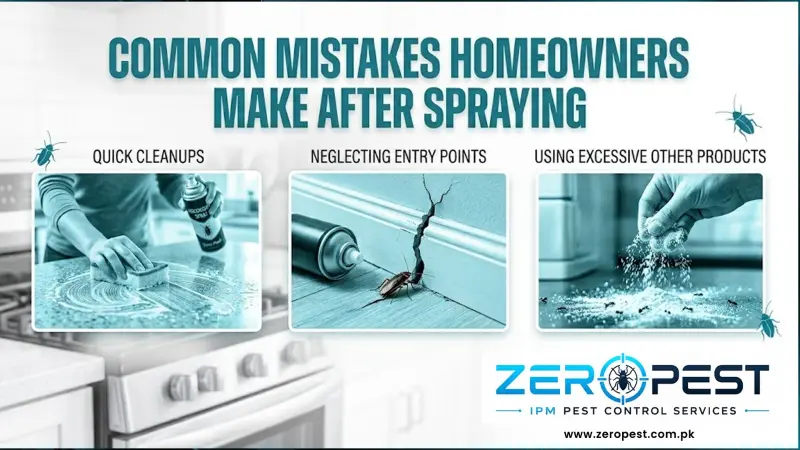
Cockroaches will eat anything: crumbs, grease, or moisture on a damp sponge. Once the food source is available (open pet food, unwashed dishes, or crumbs left behind after meals) and the roaches have been sprayed, they return to the same areas for food because their needs haven’t changed.
Entry points are still open.
Cracks in walls, gaps around pipes, unsealed vents, and gaps under doors serve as ‘highways’ for cockroaches to travel from one apartment to another, to a drain, and outdoors. These entry points remain unaffected by indoor spraying; new roaches can continue to invade after an indoor spray.
Neighboring properties or apartments cause reinfestation.
In apartment buildings and shared-wall homes, treating just one unit often isn’t enough. Cockroaches move freely between neighboring flats through shared plumbing, ducts, and wall voids, so an infestation can return simply because it was never eliminated next door.
German cockroaches reproduce very quickly.
Saving energy in one unit in shared-wall or apartment buildings may not be sufficient. Cockroaches can readily spread from flat to flat via shared plumbing, ductwork, wall voids, etc., and an infestation can reappear simply because it wasn’t eradicated in the adjacent flat.
One treatment is usually not enough.
Cockroach control is seldom a one-shot solution. A single spray will only kill roaches at that time, not eggs in the process of development, and not roaches in cracks where they are hibernating. Long-term control usually requires repeated treatments over several weeks.
When DIY Solutions Are No Longer Enough
Some infestations may be too large for a store-bought spray to be effective. If it’s time to think about professional treatment, it’s typically when:
- Cockroaches are active during the day; if they are seen, they may indicate overcrowding.
- Egg capsules are commonly observed around the house.
- Infestation is extensive or spread throughout rooms.
- It is a restaurant or commercial kitchen with paramount health and hygiene requirements.
- The building is an apartment complex with common walls and plumbing.
- After spraying several times, cockroaches have returned.
This is the point where it’s typically not that the person didn’t do enough, but that the person didn’t actually treat the source of the problem. At this stage, you need a professional like Zero Pest who is experienced in residential and commercial cockroach control and offers long-lasting results that keep your space cockroach-free for a long time, and is more effective than buying 2 to 3 spray bottles each month.
How Professional Cockroach Control Provides Long-Term Results
A good professional cockroach control service like Zero Pest deals with the problem in a completely different way than a can of spray. The first step, usually, is a detailed survey to determine the extent of the infestation and the species being present. Then the professional concentrates on finding harbourages, where the activity is actually being done, not just where it is visible.
Professionals will typically apply gel baits that cockroaches carry back to the nest, killing cockroaches that are hidden where a spray would not reach. Insecticides are also used in critical entry points and hiding areas to ensure continued protection for an extended period after treatment. Follow-ups are scheduled into the process because a single visit will not eradicate a “mature” infestation and will result in the capture of any new roaches that hatch. Technicians also make recommendations for prevention, sealing entry points, dealing with moisture problems, and better sanitation practices so that conditions are not conducive to re-infestation.
That’s why the best pest control companies always provide better lasting results than repeated spraying at home.
Frequently Asked Questions
Sprays generally only kill the roaches seen during the spray application. Eggs, hidden nests, and roaches that survive in egg cartons, cracks in walls, or behind appliances will reappear within days or weeks.
The effectiveness of treatment depends on the size of the infestation, but generally gel baits, residual applications, follow-up visits, and prevention will provide protection for several weeks to months.
Yes. Cockroach eggs are encased in a tough, impervious shell known as an ootheca, which most sprays are not able to penetrate. This is one of the primary reasons why infestations tend to reappear, even after a home is sprayed.
Not necessarily, but it shouldn’t be overlooked either. Cockroaches are nocturnal insects and are found hiding in the daytime, so if you encounter one in the day, there’s probably a bigger population of cockroaches in the area.
Spraying is not enough to provide long-term prevention; sealing entry points, fixing leaks, storing food properly, maintaining cleanliness, and using targeted treatments such as gel baits are all necessary. Professional pest control is typically the best long-term solution for persistent infestations.
Final Words
As you know, there are multiple reasons why cockroaches are coming back even after spraying. Cockroach eggs easily survive, while your spray also can’t reach the harborage areas. The availability of food and water provides an entry point for cockroaches to seek shelter and start reproducing. One spraying can only ever deal with what can be seen at the moment, and is why so many homes have the same infestation constantly recurring.
The only way to get real lasting cockroach control is to find and fix the underlying problem, not spray and re-spray. If after your efforts, cockroaches continue to visit your home and/or business, then you need a professional cockroach inspection. Contact Zero Pest for pest control services in Islamabad and Rawalpindi to get a detailed evaluation of the issue and a treatment plan to address a cockroach infestation that cannot be handled with market-available sprays.